
Doubling Down on AI Without a Long-Term View Is a Bet You Can't Afford to Lose
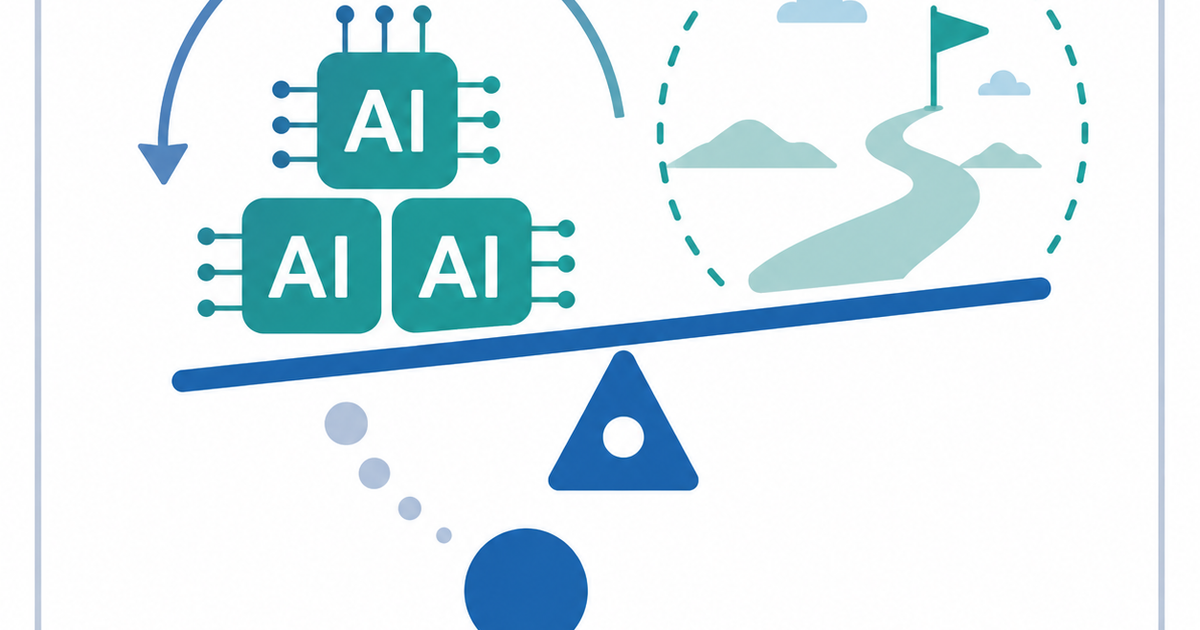
There's a pattern playing out in organizations right now that should be familiar to anyone who has watched a technology cycle complete its full arc. Companies are making significant investments in AI infrastructure, tooling, and workflows, often moving fast because the competitive pressure to do so feels real and immediate. What's conspicuously absent from most of these conversations is any serious reckoning with a straightforward question: what does this technology look like in two to five years, and does the thing we're building today actually survive that version of it? The answer, if recent history is any guide, is probably not.
The Speed of Obsolescence Has Changed
It's worth pausing to appreciate how compressed the obsolescence cycle has become, because the usual mental models most organizations carry about technology change don't apply here. When enterprises invested heavily in on-premises infrastructure in the 2000s, they expected a multi-year return horizon. When SaaS platforms took off in the 2010s, the typical useful life of a given tool was still measured in years, not months. The migration pain was real, but it was spread across a long enough runway that the math usually worked.
Generative AI doesn't operate on that timeline. ChatGPT launched in November 2022 and reached 100 million users within two months, the fastest consumer application adoption in history. That is already three and a half years ago. In that window, the entire first generation of AI-native tooling has largely been absorbed, pivoted, or quietly shelved.
Consider what that period has actually looked like. Jasper, one of the early generative AI darlings specifically built for marketing copy, peaked at $120 million in revenue in 2023 and then fell to approximately $55 million in 2024, as the underlying models it was built on top of became widely accessible for free. Chegg, which had spent years building a profitable homework-help business, saw its stock fall 48 percent in a single day in May 2023 and never recovered, with its market cap collapsing from $14 billion to under $200 million because ChatGPT simply did the same thing without a subscription. Google rebranded Bard to Gemini in February 2024. A detailed catalog of AI tools that shut down or were acquired between 2024 and 2026 counted 196 entries across just 18 months, representing 95 shutdowns and 101 acquisitions, as the creative tooling layer compressed and vertical AI products got absorbed by enterprise platforms that were primarily protecting their flanks.
None of these outcomes were hard to predict. They were the predictable consequence of building a differentiated product on top of a commodity that was rapidly becoming more commoditized.
We Have Seen This Before
The irony is that every generation of technology investment produces a version of this story, and every generation of organizational decision-makers behaves as though their particular wave is different.
In the early 2000s, organizations that had made significant investments in elaborate knowledge management systems built around document repositories and static intranets watched those systems become irrelevant almost as soon as enterprise search, and later SharePoint, became capable enough to render the underlying architecture unnecessary. The investment wasn't in the wrong idea. It was in a specific, brittle implementation of that idea at a moment when the underlying capability was still immature and moving fast.
The mobile era produced a similar pattern. Companies that had built their mobile strategy around BlackBerry found themselves holding expensive technical debt when iPhone and Android rendered that platform nearly irrelevant within a few years. The organizations that fared best were the ones that built for underlying user behaviors and needs, rather than for the particular form factor that happened to be dominant at a specific point in time.
The cloud migration wave offers perhaps the most instructive parallel. Organizations that lifted-and-shifted legacy applications into cloud infrastructure without rethinking the underlying architecture discovered that they had reproduced all of the constraints of on-premises systems at significantly higher cost. The companies that came out ahead were the ones that understood they were not buying a destination but building for a capability model that would keep evolving.
What's Different About AI, and Why It Makes the Risk Worse
The obsolescence problem with AI isn't just about tools going stale. It's more fundamental than that, and it touches three things that organizations are rarely thinking through carefully.
The first is the measurement problem. Most organizations that are "going all in on AI" right now have not established baselines for what they're trying to improve. They're adopting tools and changing workflows before they have any clear understanding of what the current state actually looks like in measurable terms. When the technology shifts, which it will, they'll have no way to assess whether the next thing is actually better, because they never built the measurement infrastructure to know whether the current thing was working.
The second is the institutional knowledge problem. When organizations build processes around specific AI capabilities, those processes encode assumptions about what the technology can and cannot do at a particular point in time. This technology is rapidly improving, so those process assumptions often become constraints rather than enablers. The manual workarounds that teams develop to compensate for a current model's limitations become deeply embedded in how work gets done, and unwinding them later is a change management problem as much as a technical one.
The third is the dependency problem. Organizations that build core workflows on top of specific vendors or specific model generations are creating a kind of technical and organizational debt that compounds quietly until a capability shift makes it suddenly visible. The AI tool graveyard of 2025 and 2026 is full of products that enterprises integrated into their operations before those products were acquired, pivoted, or simply outcompeted by a new model release that made their core value proposition irrelevant.
Pace of Change Is the Only Reliable Constant
Research from METR suggests that the length of tasks AI agents can complete with meaningful reliability has been doubling approximately every seven months since 2019, with evidence that this pace may have accelerated further in 2024 and 2025. That is not a number organizations can safely abstract away. It means that the capability profile of the AI systems available to any organization is likely to look dramatically different 18 to 24 months from now, and that specific workflows built around today's capability profile may be solving the wrong problem by the time they're fully deployed.
This does not mean organizations should avoid investment. It means they should be investing differently: building measurement infrastructure before workflow automation, creating architecture that is capable of absorbing model-layer changes without requiring process rebuilds, and treating current AI capabilities as a starting point for understanding what is possible rather than a stable foundation to build on.
The Question Worth Asking
The most important question an organization can ask right now isn't "how do we adopt AI faster?" It's "what are we actually trying to get better at, and how would we know if we were?" Organizations that start there are building toward something durable. Organizations that skip that step and go directly to tool adoption are building something that may look impressive in the near term and become a liability faster than anyone currently wants to acknowledge.
Every previous technology wave left behind organizations that bet on the current form rather than the underlying direction. The ones that came out ahead were the ones that understood the difference. There's no reason to think this wave will be different.